Like every spring semester, the staff at Spring Hill Elementary School thoroughly prepare the older students for the Texas standardized tests called STAAR. For the third graders, this will be their first year taking the STAAR test. For the fourth graders, this will be their first writing evaluation. For fifth graders, this marks the end of their elementary school time as they prepare for middle school.
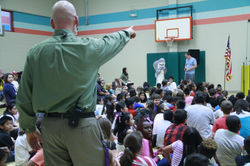
On Friday, March 24, the third, fourth, and fifth graders experienced a school day a little out of their ordinary schedule. The staff planned an awards ceremony and STAAR ¨pops rally¨ to motivate the students to continue to have fun while learning.
The gymnasium was filled with cheers and laughter as students received recognition for things like honor roll, perfect attendance, and citizenship. Parents were invited to attend to see their kids´ achievements. Though the teachers rallied a lot of cheers with special performances and funny videos, the school mascot, Sharky, stole the show.
 |  |  |  |  |
|---|---|---|---|---|
 |  |  |
“I think it’s something I’m supposed to get through, I don’t know what it’s for yet, I haven’t figured out what the challenge is and why it’s there and what I’m supposed to with it, but I feel like it’s a test and eventually that stuff will be revealed to me”
 |  |  |  |  |
|---|---|---|---|---|
 |  |  |
Looking Forward
RALLYING STUDENTS FOR TESTING WEEKS AHEAD
When you walk into the halls of Spring Hill Elementary School, teal-painted walls and colorful children’s artwork immediately greet you with an alarming brightness. Natural light shines in through every window, screaming out good morning. It feels like there’s no need for electricity; there’s enough with just the buzzing of the kids as they laugh and talk amongst themselves.
It’s almost a sharp contrast to the tall man standing smack-dab in the middle of the swarm of little people walking to their classrooms at the start of the day.
Without knowing him, his monitoring-up-and-down the halls with his ever present black shades seems almost unsettling. If strangers were quick to judge, they’d see some sort of intimidation tactic by a principal who isn’t to be reckoned with, perhaps, or maybe just a plain rude person, whilst filled with the curiosity of why exactly this man is wearing shades indoors.
To the 600 something students and staff at SHES, Dr. Troy Pitsch is simply the man who high-fives them every morning, with little dialogues that often look like, “How ya’ doin’, man? How’s your brother? Is he at school today?” or “How are things at home?”
He’s the man who sits down to eat with crying children in the cafeteria; who reassures little boys upset about stolen items, “See that?,” pointing at a camera, “We can have a look later.”
To the 600 somethings students and staff at SHES, Pitsch’s tinted glasses are as common as a person having a nose, two ears and two eyes.

A mile in his
BY JOSEFINA MANCILLA
Shades


It was his second month of his first year as the campus principal, almost 4 years ago.
Pitsch woke up expecting it to be like any other day, excited for work. Except immediately, something was off. He had no vision in his left eye. He put on his contacts and at first thought his terrible sight without them just made him put the contact in wrong. He took it out and put it back in, but his vision was still wrong.
What the heck, he thought. All he could see was like a funhouse mirror, he said, but worse.
What the heck. What the heck. What am I missing? He thought over and over again. There had to be a simple fix he was missing, in plain sight. He was missing something.
“It was the moment I realized that it’s not a simple fix that really scared the heck out of me,” he said. “When you realize I can’t fix it. I can’t fix it here at the house. It’s not a home remedy. That’s when that unknown comes in, when you don’t know what’s coming. It gets real terrifying. I was scared. I was terrified.”

Not knowing if it was a disease, if the vision loss was going to spread, if he would soon not be able to see from both eyes, he called his eye doctor immediately. That same day, she referred him to a retinologist. It was then that he realized the situation was serious.
His retina had detached from the back of his eye, and was just floating around. Three days later he had surgery.
“It was so fast. I really didn’t know what was gonna happen, I just knew that this was a pretty significant issue, and I wasn’t thinking long term, I was focused more on the immediate,” Pitsch said. “When you start to think about even for a second, what it would be like to try and navigate the world as somebody without vision...my focus was on the now, how will I drive? How will I work? How will I take care of my family? It wasn’t a good place to be.”
Despite how terrifying the vision loss was, Pitsch said what was even more terrifying was the doctor saying that the surgery was a gamble. There was no knowing if it would work.
“I tried not to let myself go down too many bad roads, and of course, the medical staff that I was working with were very supportive, but they also left it open like ‘you know, this may not work out the way you want it to, and you gotta be prepared for that,’” he said.
When he woke up from surgery, there was still no vision in his eye. All he could see was a little gas bubble floating around.
For about three weeks after the surgery, Pitsch wasn’t allowed to lay on his back at all. Still out of work, he navigated around his house during those weeks with only vision in his right eye, bumping into things often and learning to look around a little bit more. It took an additional month for his eye to fully recover, or rather, recover to the full extent that it would.
“After, my vision kind of emerged, but didn’t,” Pitsch said. “What it was, was a bright light. That’s all I could see out of my eye, and it was blinding. It was to the point of giving me a headache within just a few minutes of being exposed to any kind of light.”
His opthamologist and the retinologist said it was just a byproduct of the surgery, and they weren’t sure if it would ever go away. Their suggestion to him was to accommodate to it, since there was a real possibility that it would be permanent.
“It’s a pretty tough thing to do, considering that I’ve never had any problems like that,” he said. “To say, ‘okay, from now on you’re gonna be sensitive to light to the point where you’re either gonna have to cover up your vision and protect it, or you’re gonna have to manipulate your surroundings in order for you to not have massive headaches and things like that.’ That’s kind of how it went down.”
In the weeks following the surgery, Pitsch said his family was very supportive, rallying behind him, asking him what they could do, what he needed from them. Never having been through something like this before, however, Pitsch said, “I couldn’t answer that question because I didn’t know what I needed.”
Little by little, he began to relearn little things that were completely altered by this vision problem. Things like learning how to drive with just one eye, not just to work and back, but also to the University of Texas, where he was finishing up his doctoral program.
The biggest adjustment he had to make, though, was figuring out how to work with his light sensitivity. That’s where things got really tough.
At first, Pitsch tried to adapt his environment to himself, manipulating the dimness of light around him, but he soon realized this was not practical.
“I’m in a school, other people have to see, they have to be able to read,” Pitsch said. “So I can sit in a room with lights down and do my thing, but how does that work for the rest of the people I’m working with? It’s not just about me.”
So his next move was to adapt himself to the environment. The very bright, non-light-sensitive-friendly environment of an elementary school, where all the lights are fluorescent and teachers and administrators are constantly working on bright screens.
“This is probably the worst setting for somebody in my situation,” he said. “So again, we had to go with radical.”
His radical solution was finding the right pair of sunglasses that had the right amount of dimness. He went through six or seven pairs just trying to find the ones with the right filter. It was like a Cinderella fairytale for a pair of shades. Does the shoe fit?
The novelty was fun...for about 20 minutes. Until he realized, now, his dilemma was having to explain himself to people over and over again.
“That’s something that I had to learn to do—was just accept that I’m gonna have to explain to people that’ve never met me before what’s going on because otherwise it can be a little bit imposing,” he said. “It can be kind of off putting for some folks. A lot of people will see it as disrespect that a person won’t take off their glasses long enough to look them in the eye.”
Soon enough, however, his students, students’ parents and staff all knew the story, and the questions stopped. For the most part. Ever so often, there are new children and parents with inquisitive minds, and after years of wearing his shades, receiving puzzled looks, and giving explanation after explanation to new faces, Pitsch still patiently explains his situation to those inquisitive minds.
Despite the way it drastically changed his life, Pitsch is doing okay now. He finished his doctorate. He continued running Spring Hill Elementary School, using his experience as a teaching opportunity for the young minds there, and next year he will be moving back home to Kansas as the new superintendent for a school district up there.
“For those of us that are religious, I think it was a test,” Pitsch said. “I think it’s something I’m supposed to get through, I don’t know what it’s for yet, I haven’t figured out what the challenge is and why it’s there and what I’m supposed to with it, but I feel like it’s a test and eventually that stuff will be revealed to me”
